Generating images without backpropagation
These images were generated by a model trained without backpropagation.
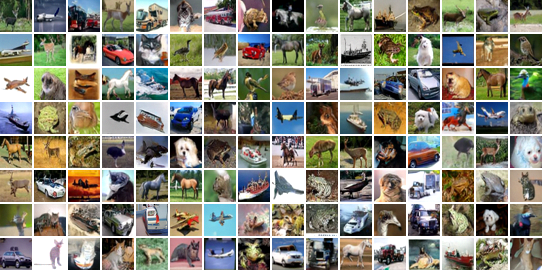
A question I’ve been working on during my PhD is: can AI learn using only local signals, closer to how the brain might, and still compete with backpropagation? If it can, both training and inference could run directly on neuromorphic chips that compute with physics and could use a tiny fraction of a GPU’s energy, at a time when energy is becoming a bottleneck for scaling AI.
Almost all of today’s machine learning relies on backpropagation, a separate backward pass that sends error signals through the whole network. That’s widely thought to be implausible in the brain, and it’s impractical on analogue neuromorphic hardware, which computes by letting a physical system settle into a low-energy state.
In my new preprint, PotentialEP, I train a 50M-parameter generative model using only local learning signals, with Equilibrium Propagation. On CIFAR-10 it reaches an FID of 3.64, against 3.54 for the same network trained with backprop. Generating an image and learning from data both become one physical process: relaxation.
There’s still a long way to go: simulating relaxation on GPUs is slow, and the real payoff needs hardware that does the settling natively. But the quality gap with backprop turned out to be far smaller than I expected.
- Paper: arxiv.org/abs/2610.14409
- Code and checkpoints: github.com/alexgower/PotentialEP
Built on Energy Matching by Michal Balcerak and colleagues. Thanks to Joachim Wabnig for his support throughout.